

When Spirit Awakens Truth.
A Pentecost Meditation with Hildegard of Bingen, Søren Kierkegaard, and CG Jung


I woke up to the morning sun breaking through the early morning sky. It was still dripping from the big trees along the street while the sun light streamed through the wet canopy. The birds were singing and the air was laden with the bliss of an early morning in Spring, when the homes are still sleepy while bunnies and birds go about their day.
We have opened the tomb, dear people, and new life broke in. Today, on this Pentecost Sunday which marks also the end of the Easter season, I am sending you these early morning sun rays, along with an essay on truth and spirit, an invitation and a blessing. May they do what our mind often struggles to do. To let the spirit flow.
And since this Cloister has always been about holding mind and heart in the same breath, I brought us some wise companions for entering this Pentecost season: Hildegard of Bingen, Søren Kierkegaard, and C.G. Jung — three teachers who have shaped my intellectual and spiritual life — asking them what they could tell us about the spirit breaking in. I hope the resulting contemplation will nourish both mind and heart on this long weekend.
The essay pairs well with something else I want to make sure you do not miss: our Moral Monday zoom circle on June 1, the last one before summer. Chuck has written about an ordinary hero of our times — someone speaking truth to power in the spirit of this very day. If you have not yet joined us for a Moral Monday hour, this would be a wonderful time to join us. It is where our paid subscriber circle gathers to share our concerns and hopes for this aching world, and we close with candle lighting and prayer. Make sure to register — details in the appendix.
And finally, Hannah has sent a little gift for this long weekend — a blessing for Memorial Day, for all who need one. Make sure to scroll down for it.
But now: may the spirit enlighten us — may it be so, Amen.
***
Pentecost has always puzzled me.
What does “Spirit” actually mean?
The word itself has become strangely thin in our time. Sometimes it means enthusiasm. Sometimes vague spirituality. Sometimes merely uplift. And often, in modern life, spirit has almost disappeared altogether — dissolved into psychology, productivity, or politics.
Yet the ancient Pentecost story speaks differently.
There is Wind. Fire. Speech. Courage. People, suddenly, are able to understand one another across divisions of language and world. Something descends upon surprised human beings and makes them alive in a new way.
But what is this “something”? And what does it have to do with us — with the spirit within us?
Over the years, I have found myself returning again and again to three unlikely teachers: Hildegard of Bingen, Søren Kierkegaard, and Carl Jung. A medieval mystic. An existential philosopher. A depth psychologist. And strangely, all three circle around the same mystery: what makes a human being truly alive?
And how does the Spirit from above meet the spirit from within?
I. St Hildegard: The Spirit as Greening Power
For Hildegard, the Spirit is inseparable from what she called viriditas — the greening power of life itself.¹ This is not a vague or decorative concept. As I have argued elsewhere, viriditas is the green thread connecting Hildegard’s entire cosmological, anthropological, and ethical vision — the sacred life force that gives all living beings breath, life, and flourishing.²
She imagines divine life not as an abstract category, but as the living breath flowing through creation like sap through a tree. Your soul is like the sap in the tree, she writes.
Can you even imagine?
That pulsing, living sap which feeds the whole tree — that is what the soul wants to be in us: flowing, greening, inhabiting every inch.
In the Liber Divinorum Operum, Hildegard records what she heard in a vision — the Spirit’s own self-disclosure:
”I am the fiery life of the Divine essence: I flame above the beauty of the fields; I shine in the waters; I burn in the sun, the moon, and the stars. And, with the airy wind, I quicken all things vitally by an unseen, all-sustaining life.”³
— Hildegard of Bingen
For Hildegard, the descent of the Spirit at Pentecost finds its deepest echo in viriditas itself — the ongoing re-greening of the world, and of the soul.
Not the soul as a disembodied ghost hidden somewhere inside us, but the inner living quickening capable of becoming green or withered, supple or dry. Spirit is not opposed to embodiment. Spirit animates embodiment. It makes life alive.

And yet Hildegard alone is not enough. Because viriditas can too easily be sentimentalized — dissolved into wellness language, vague vitality, “energy” and “flow.”
We can speak of greening while avoiding the difficult work of truth-telling. This is where Kierkegaard enters, like a northern wind.
II. Søren Kierkegaard: The Spirit as the Unseen Driver of Self-Becoming
Kierkegaard poses the problem of spirit in a different, more unsettling register. In a passage I have returned to many times in my own teaching, he writes:
“Just as the wind drives the mighty ship but does not understand itself, just as the river drives the wheel but does not understand itself, so a human being can achieve amazing things, encompass a multifariousness of knowledge without, however, understanding himself.” (Søren Kierkegaard, UDVS, 256)⁴
Here is the paradox Kierkegaard opens for us: we are driven by something we do not understand. We are moved by a spirit within — and yet we remain strangers to ourselves. The human spirit is real, active, powerful — and largely opaque to itself.
This is where Pentecost becomes not merely comfort but challenge. The Pentecost question, in Kierkegaard’s terms, is not only: did the Spirit descend? It is: are you present to receive it?
For Kierkegaard, spirit awakens when the self stops fleeing itself and stands — trembling and real — before God. He speaks of two possible movements at the boundary of despair: the self can close itself up with itself, or it can walk through the despairing moment to find itself anew.⁵
The disciples in the upper room had done exactly this. They had sat in their fear. They had not fled into distraction or performance. They waited, inwardly exposed. And into that waiting — the Spirit came.
This is the existential logic of Pentecost: the Holy Spirit does not descend into a crowd performing piety. It descends into gathered, frightened, inwardly present human beings.
The human spirit must be paying attention, be awake to be met.
Kierkegaard also understood that this is not simply a matter of inner sincerity. It requires what he calls appropriation — not in any cultural sense, but in the most existential one: the costly personal act of taking truth to heart, making it one’s own, not merely knowing it from the outside.⁶
Pentecost, in this reading, is the moment when appropriated truth — truth embodied, truth shining through in our voice and life — becomes speech. The disciples do not simply feel inspired. They become capable of witness. Capable of standing visibly in the world.
The Spirit burns away what is merely performed. It awakens what is real.
III. CG Jung: The Spirit as Transformer of the Depths
Jung stands at the threshold between theology and psychology. He understood that modern people could no longer simply inherit religious language unchanged — yet neither could they survive without the realities those symbols pointed toward.
In my own writing I have drawn on Jung’s understanding of the divine birth as something that happens in us, always, and against the odds.⁷
The lutheran pastor’s son CG Jung saw the liturgy of the church year as symbols touching the deep images or archetypes we carry in the soul.
The Divine wants to come home. Wants to dwell even in our unkempt and chaotic interiors. The sublime takes shelter in the ordinary human person.
For Jung, the movement of spirit in Pentecost is the emergence of what he called the transcendent function — the capacity to speak from somewhere deeper than the ego, to carry symbols that bridge the conscious and unconscious life.
Suddenly, fragmented and fearful people become capable of symbolic speech. Something alive moves through them. What the disciples spoke was not ideology. It was not performance. It rose from depth — from a place where the human spirit had been met by something it could not manufacture.
Jung might say: spirit is what interrupts deadness. It breaks rigid patterns. It enlarges consciousness. It reconnects us with meaning.
And it transforms fear — not by removing it, but by transcending it.
IV. The Question Between Them: Human Spirit and Holy Spirit
These three teachers do not say the same thing. And that tension is precisely what is useful.
Hildegard’s Spirit moves cosmologically — breathing through creation, greening the soul from outside and within, connecting the individual to the whole symphony of being.
Kierkegaard’s spirit moves existentially — it is the restless, often self-eluding energy of the human self straining toward God, capable of despair or of breakthrough, never merely given but always requiring inward work.
Jung’s spirit moves depth-psychologically — it is the transformative principle already present in the unconscious, awaiting encounter, capable of erupting into consciousness as symbol, dream, or — at Pentecost — as fire and speech.
The question that gathers all three: how does the human spirit — restless, partial, often self-deceived — meet the Holy Spirit?
I think the Pentecost story answers this question in a remarkably concrete way. The disciples were not spiritually advanced. They had not meditated in mountain caves. They were frightened people hiding behind closed doors. What they had done, perhaps the most Kierkegaardian thing imaginable, was stay with their fear rather than flee it. They waited. They did not yet know what they were waiting for.
And into that staying — ruach, the wind, the breath, moved. Not into performance. Not into certainty. Into the gathered, inwardly present, humanly flawed but honest company of people who did not yet know what they would become.
Hildegard’s viriditas broke through.
Kierkegaard’s human spirit, which had driven the ship without understanding itself, was met by the eternal spirit, speaking in and through them.
Jung’s transcendent function opened. They could speak in ways they had never spoken before — across divisions, in languages not their own.
This is why Pentecost still matters now, in an age drowning in distraction and noise, where words themselves feel damaged, where truth hast lost its home; and where many feel inwardly fragmented, unable to speak truthfully anymore.
Pentecost begins exactly where we are: with frightened people, behind closed doors, not yet knowing.
Then wind enters.
Breath.
Fire.
Speech.
Not certainty. Not ideology. Not performance.
Living speech — rooted in something deeper than fear, greener than despair, older than any single self.
May it be so also for us.
Much love to you in this season of growing and greening, Almut
PS: If you can, leave a heart, a word or a line which resonated with you in the comments, so we know you have been here :-)
¹ “Viriditas,” the greening life force: for a full theological treatment, see Almut Furchert, “Praising Spring’s Greening with Hildegard of Bingen,” Cloister Notes, April 23, 2025.
² Almut Furchert, “Cosmic Partnership: Hildegard of Bingen’s Vision of an Integral Ecology,” The Journal of Social Encounters, Vol. 8, Iss. 2 (2024), pp. 310–326.
³ Hildegard of Bingen, Liber Divinorum Operum. The passage is spoken by Caritas, divine Wisdom — a point often missed in popular citation. The full text continues: “For the air is alive in the verdure and the flowers; the waters flow as if they lived; the sun too lives in its light.”
⁴ Søren Kierkegaard, Upbuilding Discourses in Various Spirits (UDVS), 256. Cited in Almut Furchert, “From the God of the Father to God the Father: Kierkegaard’s Spiritual Narrative as His Point of View,” International Kierkegaard Commentary, vol. 22, ed. Robert L. Perkins (Mercer University Press, 2011), pp. 359–376.
⁵ On despair as a boundary situation: Almut Furchert, “Create Possibility! Kierkegaard’s Remedy Against Despair,” Cloister Notes, November 14, 2024; and Furchert, Das Leiden fassen: Zur Leidensdialektik Søren Kierkegaards (Freiburg: Karl Alber, 2012).
⁶ On appropriation as a central Kierkegaardian concept: Furchert, “From the God of the Father to God the Father,” pp. 369–374.
⁷ C.G. Jung on the divine birth as occurring within the human soul: cited in Almut Furchert, “The 11th Day of Christmas: Are We There Yet?” Cloister Notes, January 4, 2024.
Coming up at The Cloister
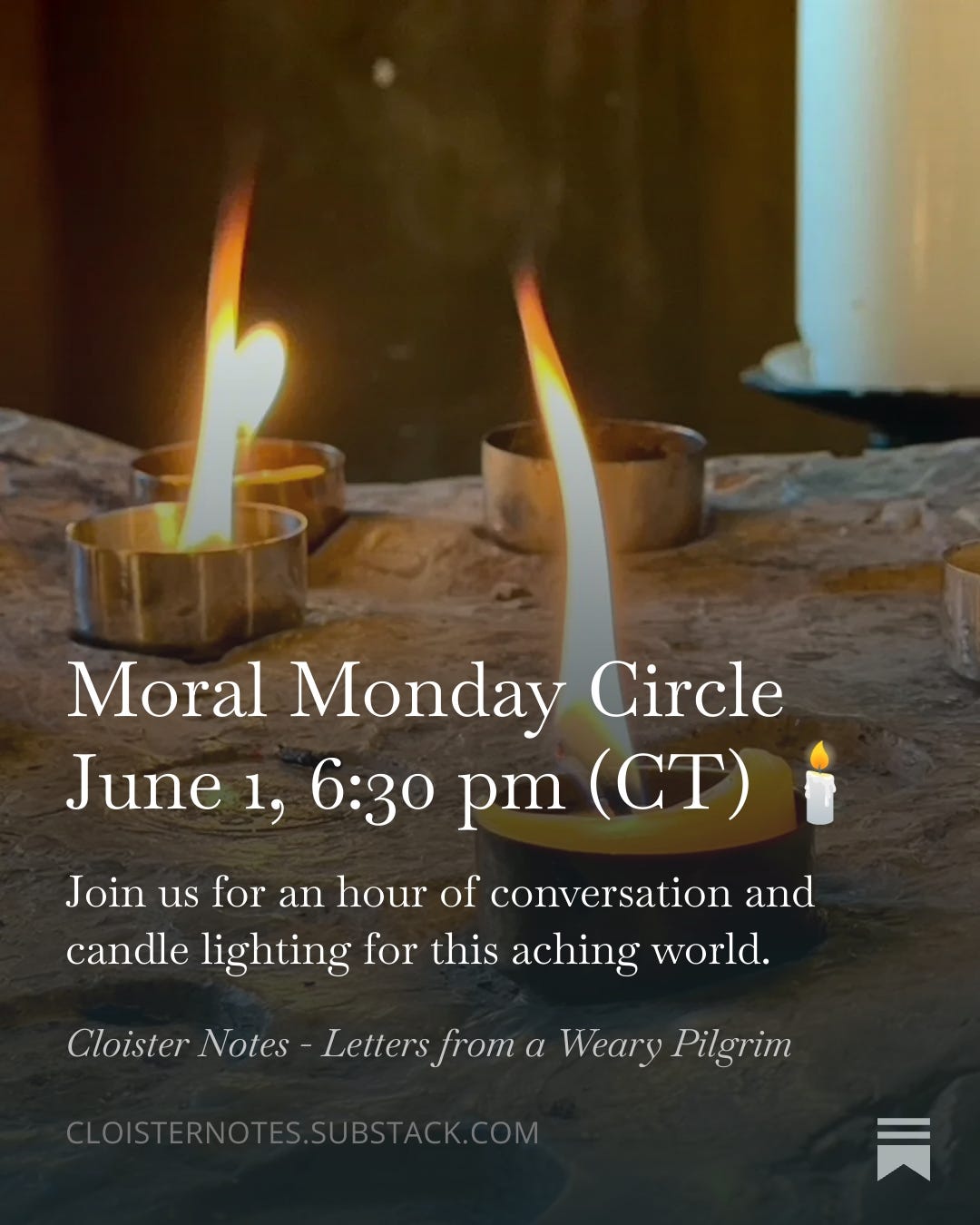
Please join us for this June’s version of Moral Monday, on June 1, 2026 at 630 PM, Central Time.
We gather on these Mondays to think about current issues in our world and in our lives, to share our concerns, and to light a candle at the end. This time we will read a short essay by our Chuck Huff on the Republican politician Liz Cheney and the role of truth and virtue in our world today. And since this is our last circle for the season we will also share some thoughts about where our Moral Monday gatherings may lead come Fall.
Truth has become a tool rather than a benchmark. Liz Cheney’s dedication to telling the truth of the storming of the Capitol on Jan 6, 2021 shows us how closely truth and virtue are connected. When pride and power shut down critique, then we lose truth. But we also lose virtue, because we cannot become better persons without learning from critique.
How to register
Please make sure to register to receive your zoom link.
Moral Mondays are a gift to our paid community. If you wish to join us, you can upgrade below before registering.
More Readings from The Cloister


A Memorial Day Blessing
And finally, a blessing for this long weekend, inspired by our then six year old.
Thank you for reading, sharing, and supporting Cloister Notes, an independent letter for dancing monks and weary pilgrims, a place to deepen your path and listen for the wisdom within. Your presence helps keep this small cloister alive.
If what you find here speaks to you, you are invited to join as a free or or paid subscriber, and become part of this communion of fellow pilgrims. Paid subscribers sustain this work, keep it open to all, and are part of the inner cloister, with access to our archive, live gatherings, and seasonal contemplations.
You can share this letter by simply forwarding this email, by sharing it on your social networks, or if you are a substacker, by restacking it. Thank you, thank you.
❤️❤️
it's the right thing to do...wait and stay in your fear...